
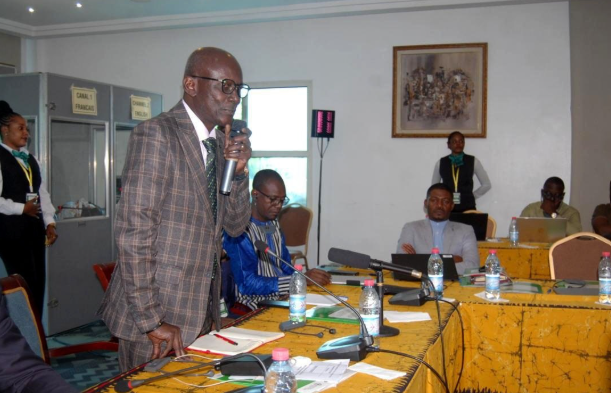
As part of efforts to improve border governance in Africa, the heads of West Africa's National Border Commissions held their second meeting on 19 and 20 August 2025 in Cotonou, Benin. This was followed by a meeting of the Platform for Exchange and Coordination on Border Management in West Africa (PECOGEF) on 21 and 22 August 2025.
These strategic meetings are part of a regional initiative aimed at strengthening border governance through the consolidation of ECOWAS and UEMOA mechanisms and the renewal of PECOGEF's governing bodies.
The meeting also provided a framework for sharing experiences and best practices in border governance and border issues, giving new impetus to PECOGEF through its institutional restructuring, planning bilateral and multilateral activities related to border management.
After the ad-hoc committee presented the interim results of the review of the platform's regulatory texts, the participants proceeded to renew its governing bodies.
Mr. Francis Langumba KEILI, Chief of Staff in the Office of National Security of Sierra Leone, was chosen to chair the Executive Board, with Mr. Seydou OUANE, National Director of Borders of Mali, as Vice-Chair. As for the Executive Committee, Senior Prefect Diakalidia KONATE, Executive Secretary of the National Border Commission of Côte d'Ivoire, was appointed Executive Secretary, and Brigadier General Anthony NTEM, Commissioner General of the Ghana Boundary Commission, and Dr Adam YOUSSOUF, Director General of the Benin Agency for Integrated Management of Border Areas, as first and second Deputy Executive Secretaries respectively.
At the end of the meeting, the new leaders committed to continuing the reforms needed to strengthen the platform's impact on the stabilisation and socio-economic integration of border areas.
It should be noted that the event brought together representatives of Member States, the African Union, UEMOA, technical partners (IOM, AFRIGIST, African Parks) and local border communities.
The event's discussions highlighted the strategic and operational importance of the platform for border governance in West Africa, signed up a Communique and developed a roadmap for the Platform on Exchange and Coordination on Border Management (PECoBoM), in addition to bilateral and multilateral planning of activities among member States.
According to the signed Communique, PECoBoM was tasked with Strategic leadership and regional credibility to uniting Member States around a common agenda and promoting shared interests and regional synergies; clearly affirming the platform's regional vocation to regional and continental organisations as a forum for coordination, dialogue and action on border governance in West Africa.
PECoBoM is also expected to develop a resource mobilization strategy by identifying technical and financial partners aligned with the objectives of the new regional body and develop multi-year programmes/projects and action plans to ensure sustainability.
The new regional body also plans to engage in capacity building and development of regional expertise through the training of teams in border governance, territorial diplomacy and crisis management; and create a pool of regional experts who can be mobilized for technical missions and ad
-hoc support, among others.
The participants recommended that the African Union include the PECoBoM as an official regional platform in the African Union Border Programme (AUBP) in West Africa and integrate the results and recommendations of the new border management platform into continental policies on peace, security and territorial development, among others.
PECoBoM also recommended for the harmonization of legal and operational frameworks to promote administrative, customs and health procedures relating to border management, to facilitate the free movement of people and goods and facilitate trade; encourage the establishment of continental mechanisms for resolving border conflicts and support the creation of a continental training programme on border governance through inter-regional exchanges between border management practitioners.
The Communique also encouraged member states to allocate specific budgets to border cooperation in national finance laws and facilitate access to regional and international funding to support cross-border projects; Promote proactive border diplomacy, based on dialogue, prevention and cooperation and support PECoBoM resolutions in regional and continental bodies.
The Communique also highlighted the need for Local and community capacity building by training local players (local authorities, security forces, Civil Society Organizations) in concerted border management; support community initiatives for peace, development and conflict prevention; adopt common protocols for crisis management, security and mobility in border areas and support the establishment of cross-border cooperation bodies.
End.
StratCom@ONS
www.ons.gov.sl
Toll-free Line: 119